Blog > Book - Where wizards stay up late
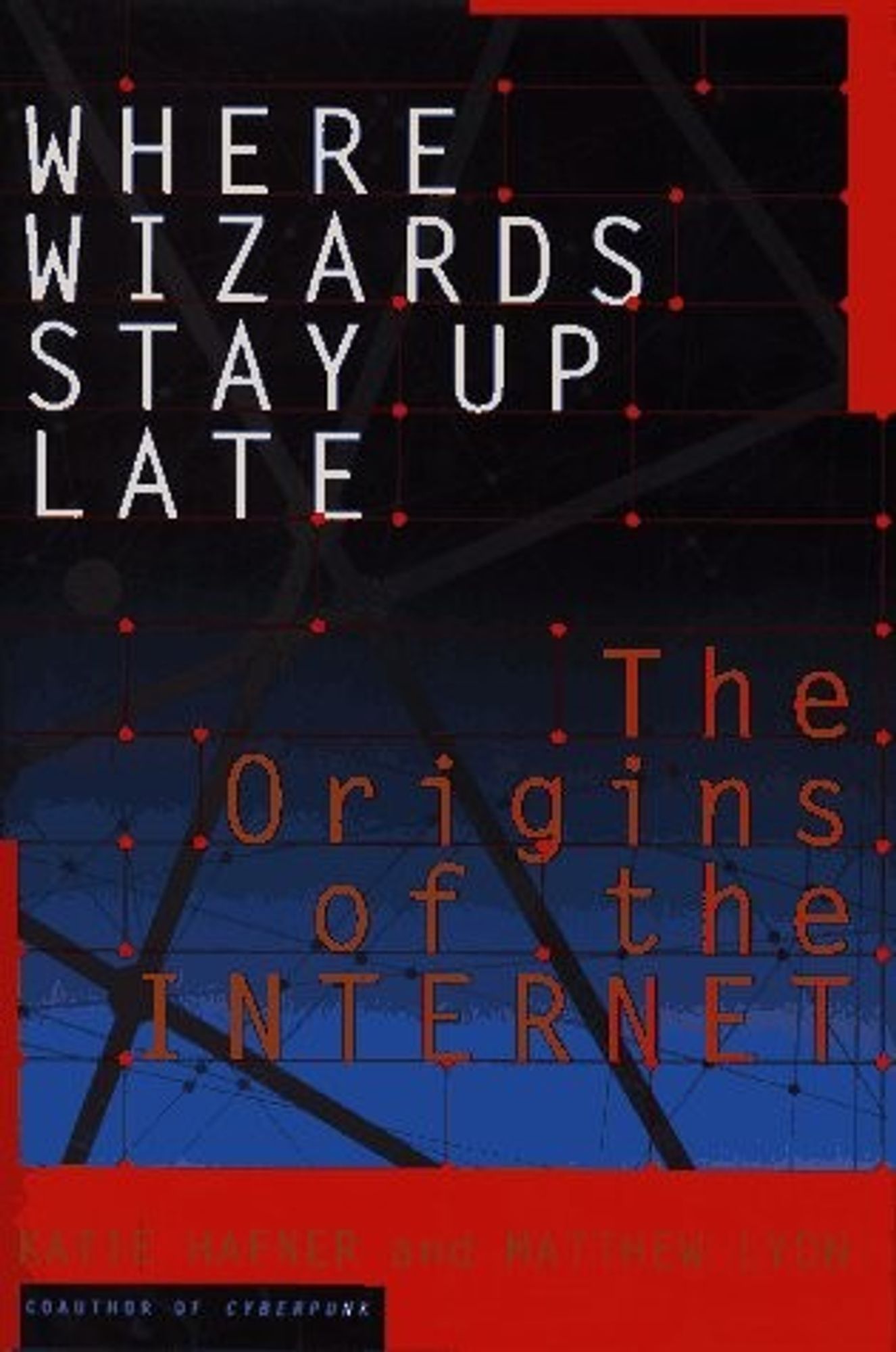
Author: Katie Hafner and Matthew Lyon
Year: 1996
Publisher: Simon & Schuster
ISBN: 0-684-81201-0
Note: a .pdf version of this book can be found here: https://monoskop.org/images/e/ee/Hafner_Katie_Lyon_Matthew_Where_Wizards_Stay_Up_Late_The_Origins_Of_The_Internet.pdf.
The epilogue of the book reveals that the Bolt Beranek & Newman (BBN) company was behind the idea of writing this book. BBN wanted to bring attention towards its pioneering role, during the late 1960s, in the construction of the network that would evolve into the Internet. I do not dare to call it sponsored content since I really think the people at BBN had a major role in the success of this early stage of the Internet, but let this warning come back to our mind whenever the book looks too BBN-centric.
For a start: the full title is Where wizards stay up late - The Origins of the INTERNET (INTERNET in capital letters).
The title is inspired by this poem by writer James Merrill, "Under Libra: Weights and Measures," from Braving the Elements:
Los Alamos' lights where wizards stay up late
(Stay in the car, forget the gate)
To save the world or end it, time will tell
I have forgotten where I first learned about this book. Got it this year, 2025, at IberLibro online bookshop, from a french book seller. The book arrived with stamps from the library of the Laboratoire de recherche en informatique of the Université Paris-Sud, d'Orsay campus, and a card showing that only one person borrowed it in 1997.
The book tells the story of the ARPA's effort to build a packet switching-based computer communications network, in opposition to the, then, common circuit switching approach.
The first half of the book describes the origin of the project, the organization of ARPA within the Department of Defense and the details of the development of the element that made the network possible: the Interface Message Processor (IMP).
Also, there is a reference to the first RFC, RFC 1. Though professionally never needed this RFC 1, I did use several RFCs in my first paid job in 1997 to implement the TCP (RFC 793) and IP (RFC 791) protocols (among others) for an Intel 8088-based portable device. At that time I first heard about John Postel, editor of the RFCs back then and a prominent player in the book. I have already written about him.
A kind of laissez-faire attitude from ARPANET governance, with regards to let connected people use the network at their will, resulted in the creation of new tools and services: as login utilities, news feeds (the book mentions a connection to Associated Press news wire) or forums. But intercommunication via email became one fo the most popular tools. Starting from multiple independent approaches, it later became its own RFC 680 in 1975; though getting a RFC published did not mean meekly acceptance by community. The book states about this RFC that "immediately created a ruckus".
Also, by the end of the book, another standarization effort resulted in what became known as the Protocol Wars, or the Internet–OSI Standards War. There the Internet's TCP/IP protocol faced oppossition from the OSI networking model, which aimed standarization beyond the then limited Internet academic community. The book describes the clash like this:
But the Internet community -people like Cerf and Kahn and Postel, who had spent years working on TCP/IP- opposed the OSI model from the start. First there were the technical differences, chief among them that OSI hada a more complicated and compartmentalized design. And it was a design, never tried. As far as the Internet crowd was concerned, they had actually implmeented TCP/IP several times over, whereas the OSI model had never been put to the tests of dialy use, and trial and error.
In fact, as far as the internet communinty was concerned the OSI model was nothing but a collection of abstractions. "Everytying about OSI was described in a very abstract, academic way," Cef said. The language they used was turgid beyond belief. You couldn't read an OSI document if your life depended on it."
TCP/IP, on the other hand, reflected experience. It waas up and running on an actual network. "We could tyr things out," Cerf said. "In fact we felt compelled to try things out, because in the end there was no point in specifying something if you weren't going to build it. We had this constant pragmatic feedback about whether things worked or didn't."
Cerf and others argued that TCP/IP couldn't have been invented anywhere but in the collaborative research world, which was precisely what made it so successful, while a camel like OSI couldn't have been invented anywhere but in a thousand committees.
A few pages later the book quotes an unidentified computer sciencist in the TCP/IP faction about how standards succeed:
Standards should be discovered, not decreed.
I cannot help but going back the term "that works" in Gall's law. But unfortunately there may be other forces involved that can artificially push a committee-based standard get its way. It is not enough to be objectively better: you need support from influential people and some marketing too.
A nice recap of the origin of the Internet within the U.S. research system of the sixties. And a tale about how a simple idea as packet-switching can reshape global communications.